Law 120/2026 (formerly the "Ferragni Bill") and Charitable Promotions: 2026 Compliance Guide
The Ferragni case is closed, but it set a major precedent, resulting in a new law that directly impacts the world of promotional activities!
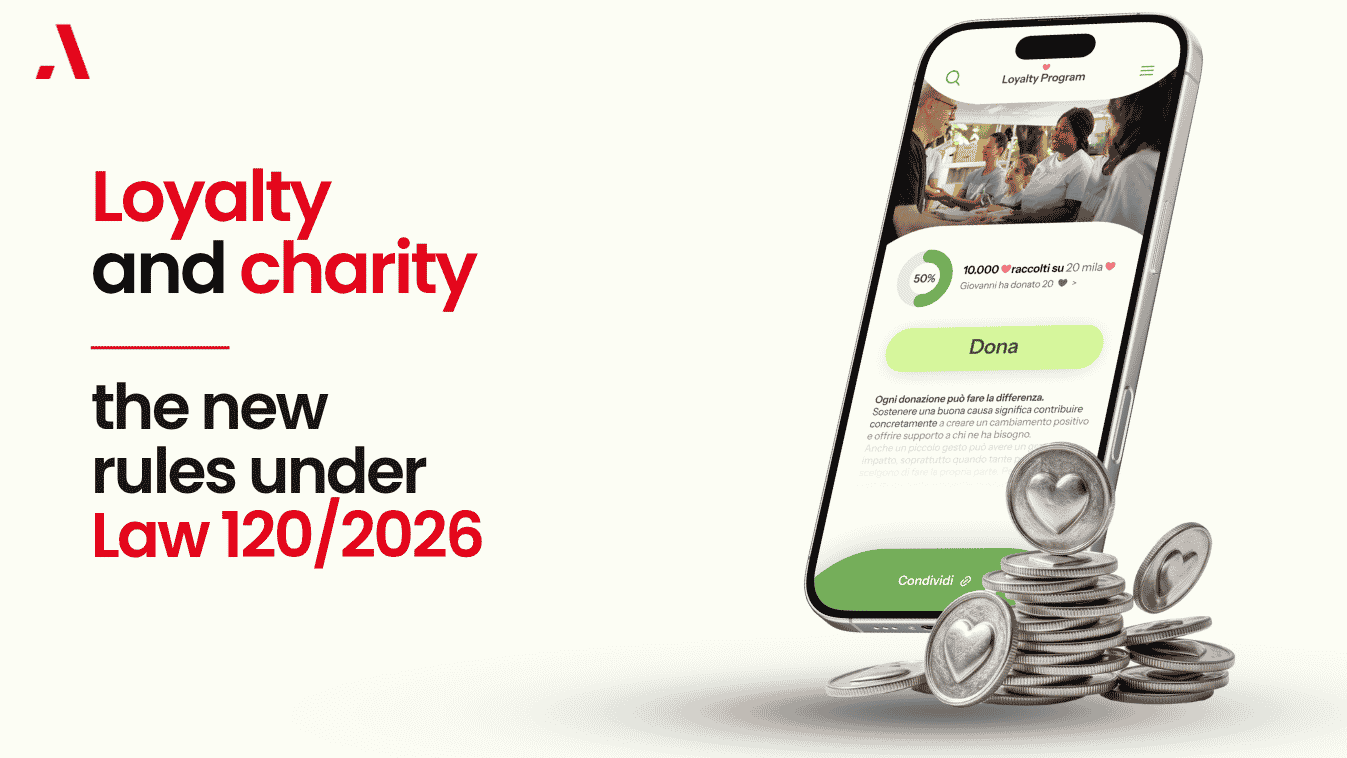
Are you a foreign company looking to launch promotional campaigns or loyalty programs in Italy? If your campaign includes charitable giving, here is everything you need to know about the Ferragni Law on transparency protection.
Law 120/2026 was created in the wake of the so-called "Pandoro Gate" to protect consumers from unfair promotional practices that fail to clearly specify the actual amount that will be donated to charity as a result of the commercial initiative.
In this article, we analyze what changes with the entry into force of the new law and present a checklist of action items to ensure your charitable promotional activities remain compliant and secure.
The Blurry Line Between Promotions and Charity
Associating a brand or product with a charitable cause is a powerful engagement strategy capable of generating reputational value and strengthening the emotional connection with consumers. Consequently, Cause-Related Marketing and socially driven promotional operations have grown exponentially in recent years.
Charitable donations can be structured in two primary ways:
- The entire initiative is designed to generate a charitable impact: the user purchases the product, and a portion of the proceeds is donated to a designated cause.
- The customer participates in a loyalty program and freely chooses to donate a portion of their accumulated value (points) to social causes instead of redeeming a reward.
In both scenarios, however, consumers must be able to clearly distinguish between the promotion and the charitable contribution so that brands avoid regulatory fines or, worse, severe reputational damage.
The approval of Law No. 120 on June 19, 2026 (commonly known as the "Ferragni Law," effective as of July 21, 2026) marks a definitive turning point. The legislature has introduced a rigorous regulatory framework designed to govern tie-in sales linked to charitable initiatives and promotional operations with philanthropic goals.
For Marketing Managers, Legal Specialists, and executive boards operating in the Italian market, compliance is no longer a mere footnote in promotional terms and conditions, but a strategic pillar of corporate governance.
A Law to Protect Confidence and Prevent the Loss of Consumer Trust
The primary fallout from "Pandoro Gate" was a severe crisis of trust within the well-known influencer’s community. Today, communities are the central focus of corporate attention. In an era where data ownership is paramount to a brand’s growth and survival, knowing how to engage and converse with your audience is vital—not only to build relationships, but ultimately to protect the business itself.
Consumers accept this dynamic; they are fully aware that behind every action and communication lies a commercial and marketing motive. At the same time, they place their trust in brands whose values and mission align with their own, and whose products and services they appreciate.
Placing trust means consenting to share personal data, agreeing to receive direct email marketing (DEM) or telemarketing communications, completing profiling surveys and interactive tasks, and participating in special—often charitable—initiatives that reflect the brand's core values.
However, if that trust is eroded by unfair commercial practices—if users realize they lacked the necessary information to make an informed choice, or if an initiative leaves an impression of opacity—the community loses trust and quickly disintegrates.
In an age of intense media exposure, a non-transparent process inflicts massive reputational damage with severe financial repercussions. This is because community trust relies heavily on an emotional connection that makes people feel genuinely "part of something”. Commercial trade-offs are acceptable only up to a point: consumers must always be fully informed.
At the core of this approach is the effective application of behavioral loyalty dynamics, which are specifically designed to engage consumers on an emotional and behavioral level. A consumer is not defined solely by what they buy, but is an individual with distinct tastes, passions, and desires that drive their personal and purchasing decisions.
What Changes for Charitable Promotions Under the New Ferragni Law
Law 120/2026 specifically targets commercial activities, directly affecting promotional initiatives and loyalty programs with charitable objectives. The primary goal is to ensure consumers are provided with crystal-clear information regarding three essential elements:
- Who the ultimate beneficiary of the donation is.
- What specific philanthropic or public utility purpose is being pursued.
- What exact amount or percentage will actually be donated.
These regulations apply to all commercial initiatives where the sale of a product or service is linked to donating proceeds—whether in whole or in part—to entities serving charitable or philanthropic purposes. The law encompasses every promotional channel used for consumer marketing: labels, packaging, websites, mobile apps, e-commerce platforms, traditional advertising, and influencer marketing.
The Two Key Updates to Keep in Mind Under Law 120/2026
1. Generic Phrases Are No Longer Allowed
Vague statements such as "a portion of the proceeds will be donated to charity" or "purchasing this product supports XY research" are now prohibited. Prior to launching an initiative, companies must explicitly define the exact calculation method used for the donation, selecting one of three specific options:
- Fixed Amount: a predetermined sum for each product sold (e.g., €1 for every item purchased)
- Percentage of Sales Price: an exact percentage of the purchase price allocated to the donation (e.g., 2% of every product sold goes to charity).
- Flat Sum Independent of Sales: a set amount determined regardless of sales volume (e.g., "This promotion is tied to a €X,000 donation to Association Y").
2. Strict Regulatory Reporting Deadlines to the AGCM
The law establishes mandatory communications that brands must submit to the AGCM (the Italian Competition and Market Authority), outlining three critical filings:
- Prior Notification at Least 15 Days Before Launch:
companies must submit a detailed notification to the AGCM containing information about the entities involved, the product, the campaign duration, the beneficiary organization, the donation calculation method, and the deadline for transferring the funds. - On-Air Campaign Monitoring:
public communications must remain strictly compliant and consistent with disclosures made to the AGCM. Any modifications must be promptly reported. - Reporting and Audit Filing:
documentary proof attesting to the actual transfer of promised funds to the beneficiary entity must be submitted to the AGCM within 3 months of the scheduled payment deadline.
Planning a Promotional Campaign with Charitable Goals?
Failure to comply with Law 120/2026 carries significant fines and severe reputational damage.
- Fines Ranging from €5,000 to €50,000: imposed for failing to submit prior notification to the AGCM, omitting final reporting, or disseminating inaccurate or incomplete information. The fine is calculated by the Authority based on the total financial turnover of the campaign, the number of products placed on the market, and their retail price.
- Unfair Commercial Practices Claims: if the promotional-charitable message is deemed ambiguous or capable of distorting consumers' purchasing decisions, consumer protection measures under the Consumer Code are automatically triggered. This exposes the company to burdensome investigations and immediate injunctive relief.
- Suspension of Promotional Activity (Up to 12 Months): in cases of severe violations, systematic opacity, or repeated offenses, the AGCM may order a suspension of the promotional or commercial activities connected to the initiative for a period ranging from 1 to 12 months.
- Mandatory Public Disclosure of Sanctions: the Authority may order the publication of the administrative penalty on the official channels of the sanctioned company (and any directly sanctioned influencers/individuals) as well as in national newspapers, at the offender’s expense. This causes substantial brand damage, undermining market positioning and audience trust.
How Law 120/2026 Impacts Prize Contests and Promotional Programs
In loyalty programs and reward catalogs, brands increasingly offer customers the option to convert points earned through purchases or engagement tasks into a financial donation to a non-profit organization.
In this scenario, point conversions fall squarely within the scope of the law: the program’s official rules, app screens, website, and e-commerce interfaces become commercial communications paired with charitable goals. Consequently, companies are legally required to transparently disclose the exact monetary value donated for specific point thresholds, submitting prior notification to the AGCM and issuing a final audit report where applicable.
The situation surrounding prize contests is distinct yet equally delicate, as the regulatory impact depends on the specific mechanics of the campaign.
A prize contest in itself (such as a traditional random drawing or instant-win promotion) is not generally governed by this law unless the promotional mechanics or marketing messaging introduce a charitable component.
For example: "Buy the product, enter the instant win, and 3% of proceeds will be donated to Association XY."
The law must always be factored in because it also applies to the common scenario where a portion of the prize pool or sales revenue is donated to a third-party entity.
In each of these cases, the entire campaign comes under the scope of the new regulations, requiring a detailed review of terms and advertising materials to ensure complete transparency in public communications.
Ensure 100% Compliance for Your Charitable Promotions and Loyalty Programs with Advice Group
Advice Group was the first company to introduce behavioral loyalty to the Italian market. Understanding consumers and engaging them in relational activities—beyond simple transactions—is in our DNA, as is building strategies that foster vibrant communities with positive social, charitable, and sustainable impacts.
Navigating the complexities of Law 120/2026 requires an integrated approach spanning loyalty design, platform technology, data management expertise, and legal compliance.
Our strategic expertise, gained over more than 20 years in the field, enables us to support companies across all industries in designing loyalty initiatives aligned with their objectives. We also manage regulatory requirements and guide consumer communication best practices. Specifically, we provide end-to-end regulatory management:
- Regulatory Advisory: validation of promotional mechanics and loyalty strategies, drafting official terms and conditions, and direct management of filings with MIMIT (the Italian Ministry of Enterprises and Made in Italy).
- Transparent Data Management: verified tracking of participation and point conversions, alongside automated calculation of charitable contributions to be donated.