Advice Group and WEKIT recognized in the 2026 Gartner®Market Guide for Loyalty Program Vendors
Technological evolution and microservices integration are transforming behavioral loyalty strategies and consumer engagement.
The 2026 Gartner® Market Guide for Loyalty Program Vendors is one of the most authoritative references for organizations looking to select the right technology partner to develop their engagement strategy or build an effective loyalty program.
Alongside an overview of the market's leading vendors and their technological capabilities, the Gartner Market Guide highlights the key trends shaping the future of loyalty, offering valuable insights into the profound changes influencing the decisions of consumers, brands, CMOs, and CTOs.
Loyalty: a rapidly evolving market
Loyalty is becoming increasingly technology-driven. The industry is experiencing a significant wave of mergers and acquisitions among customer experience and customer data management providers. This consolidation reflects a growing awareness that data ownership has become one of the most valuable strategic assets for brands, making fragmented technology ecosystems no longer sustainable.
At the same time, organizations are no longer looking for a single "all-in-one" solution. The era of outsourcing an entire loyalty strategy to one provider is giving way to a more flexible approach, where companies select specialized technologies that integrate seamlessly into their existing ecosystem.
Today's managers prefer modular platforms capable of supporting multiple business needs while remaining adaptable over time. The ability to break down technology into independent microservices has become essential for responding quickly to changing business requirements. In many cases, brands integrate only the specific functionality missing from their existing tech stack, rather than replacing an entire platform.
The rapid adoption of Artificial Intelligence is accelerating this transformation even further. Companies are increasingly bringing strategic activities back in-house, relying on technology partners only for the services they truly need, while maintaining greater control over data, customer journeys, and business processes.
Brand challenges
This transformation is driven by several challenges that companies continue to face. One of the biggest obstacles remains the presence of data silos and overlapping technologies. Organizations often invest in different software solutions offering similar functionalities, resulting in duplicated data, disconnected customer information, and fragmented business insights.
Adding to this complexity, nearly half of the features available within today's corporate technology stacks remain unused or significantly underutilized. This is often caused by poorly designed data architectures, which generate new silos instead of eliminating them, as well as by the lack of internal skills required to fully leverage existing technologies.
Meanwhile, pressure on CMOs has never been higher. Artificial Intelligence is accelerating execution while simultaneously raising expectations around measurable business results.
Marketing leaders are now expected to demonstrate clear ROI in increasingly shorter timeframes.
The focus has shifted from purely awareness-driven campaigns toward initiatives capable of generating immediate business impact, faster time-to-market, and measurable demand generation.
However, this growing focus on short-term performance often leaves fewer resources available for loyalty initiatives. Unlike acquisition campaigns, loyalty requires time to build trust, strengthen customer relationships, and create long-term value through continuous engagement and retention.
Consumers are becoming more demanding
Consumer expectations are evolving just as rapidly.
People are increasingly aware of the value of their personal data and are willing to share their First-Party Data only when they receive meaningful value in return. Personalized experiences, relevant content, and tangible rewards have become essential elements of any successful loyalty strategy.
Traditional loyalty programs are gradually losing their effectiveness. On average, consumers belong to around 17 loyalty programs but actively engage with only half of them. This reality is forcing brands to completely rethink how they build relationships and maintain customer engagement over time. This challenge becomes even greater when targeting younger generations, particularly Gen Z. To earn their long-term attention and trust, brands must move beyond transactional programs and build richer loyalty ecosystems capable of delivering continuous value through meaningful interactions. Research shows that 38% of digital natives under the age of 30 are willing to accept higher prices for products or services if they receive a significantly more personalized and relevant customer experience in return.
Emotional Loyalty, Data Loyalty, Audit Loyalty and Composable Loyalty: the new trends shaping engagement
As loyalty continues to evolve, new strategic approaches are emerging to help brands create stronger and more meaningful relationships with their customers.
Emotional Loyalty
Emotional Loyalty is about creating genuine connections between brands and people.
The goal is no longer simply encouraging customers to purchase more frequently, but building trust through relevant experiences, personalized interactions, and continuous dialogue. Every interaction becomes an opportunity to better understand customers, anticipate their needs, and strengthen long-term relationships throughout the entire customer lifecycle.
Ultimately, emotional loyalty helps brands reduce churn while increasing customer advocacy and lifetime value.
Data Loyalty
Building stronger relationships starts with understanding customer behavior.
Every interaction generates valuable information. Purchases, website visits, reward redemptions, survey responses, participation in challenges, event attendance, customer care interactions, and engagement with editorial content all contribute to creating a comprehensive behavioral profile.
This continuous flow of behavioral data allows companies to better understand customer preferences, identify future opportunities, personalize communications, and design increasingly relevant engagement strategies.
Data is no longer simply collected; it becomes the foundation for building truly personalized customer experiences.
Audit loyalty
As technology ecosystems become increasingly complex, loyalty platforms must also be capable of interpreting and organizing the enormous amount of data generated across multiple business systems.
Audit Loyalty focuses on consolidating information from different touchpoints into a clear and actionable view of customer behavior. By transforming raw data into meaningful business insights, organizations can develop increasingly accurate one-to-one marketing strategies based on real behavioral patterns rather than assumptions. The ability to continuously monitor, analyze, and interpret customer interactions enables brands to make faster, smarter decisions while constantly improving the customer experience.
Composable loyalty
Flexibility has become one of the most important requirements for modern loyalty platforms.
Rather than relying on rigid, monolithic solutions, companies increasingly expect technologies that can be easily adapted to their evolving needs.
Composable Loyalty is built around modular services that can be activated independently and integrated into existing technology ecosystems through APIs. This approach enables businesses to introduce new capabilities whenever needed, without disrupting existing infrastructures.
As customer expectations continue to evolve, composable architectures allow brands to respond quickly, experiment with new engagement strategies, and continuously optimize the customer experience.
Advice Group and WEKIT Recognized in the 2026 Gartner® Market Guide for Loyalty Program Vendors
Advice Group and the WEKIT loyalty platform have been recognized in the 2026 Gartner® Market Guide for Loyalty Program Vendors for their ability to address the latest loyalty trends through a comprehensive Behavioral Loyalty approach.
Built on a composable architecture, WEKIT is designed to help organizations create highly personalized engagement strategies that evolve alongside changing business needs.
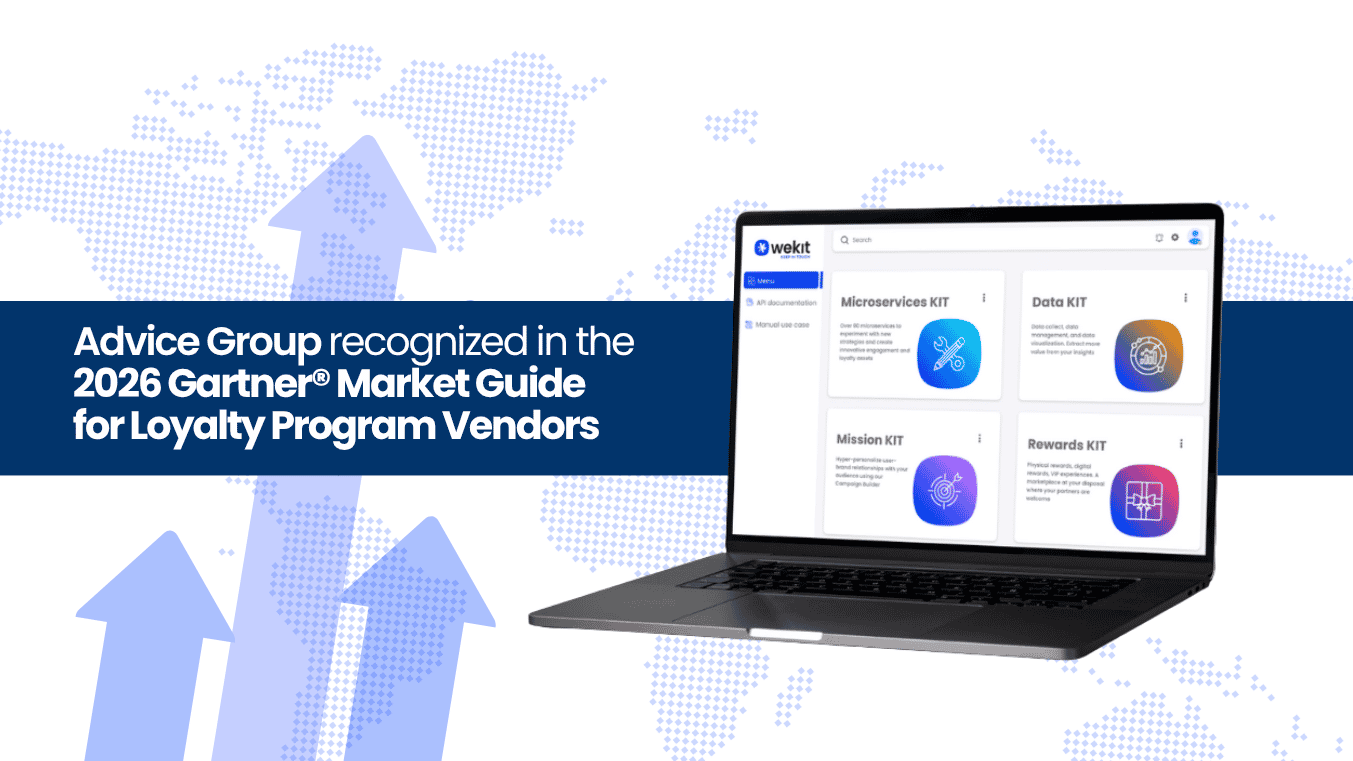
The platform is composed of four modular KITs and more than 60 microservices, which can be combined in multiple configurations to support virtually any engagement and loyalty strategy. From gamification and content engagement to advocacy, anti-churn initiatives, onboarding, and customer activation, WEKIT provides the flexibility to design experiences tailored to every stage of the customer journey.
One of the platform's core strengths is its ability to transform customer data into actionable insights.
Through DATA KIT, organizations can collect, centralize, and analyze behavioral data generated across multiple touchpoints, creating a unified view of each customer. Information is organized into intuitive, role-based dashboards that provide real-time visibility into customer behavior and business performance.
This analytical layer enables advanced customer clustering and the activation of highly personalized one-to-one journeys based on behavioral patterns, lifecycle stages, customer interests, and business objectives.
These personalized missions can support a wide range of goals, including increasing purchase frequency, encouraging cross-selling and upselling, improving recency, driving customer retention, collecting feedback through surveys, promoting editorial content, rewarding referrals, encouraging user-generated content, or delivering educational experiences.
At the heart of every successful engagement strategy are meaningful rewards. WEKIT's REWARDS KIT provides one of the market's most flexible reward management solutions, enabling organizations to build multilingual and multi-country reward catalogs in just a few clicks while offering complete flexibility in managing incentives, partnerships, and customer experiences.
Advice Group and WEKIT have been recognized within the Multi-Solution Provider category, which includes vendors capable of centralizing customer information under a unified identity through Single Sign-On (SSO), while delivering highly personalized experiences across multiple channels.
This recognition reflects WEKIT's ability to address the evolving needs of today's loyalty market by offering:
- Flexible and scalable behavioral loyalty and engagement solutions.
- Unified customer profiles through Single Sign-On (SSO).
- Advanced data collection, normalization, and behavioral analytics.
- Modular microservices that integrate seamlessly into existing technology ecosystems through APIs.
- The flexibility to rapidly introduce new features and capabilities during both the design phase and while programs are live.
- Personalized customer journeys based on behavioral clustering, customer lifecycle, business objectives, and generational targets.
Beyond these capabilities, WEKIT and Advice Group are also fully NIS2 compliant, ensuring the highest standards of cybersecurity, data protection, and operational resilience to support organizations operating in increasingly complex digital environments, as detailed in this article.
RESILIENT IN A CHANGING MARKET
Our inclusion in the 2026 Market Guide for Loyalty Program Vendors represents an important milestone, celebrating a journey of growth and technological maturity that makes us a benchmark of excellence in the international engagement and loyalty sector today.
We are ready to support you and build the most suitable strategy for your consumers, sales networks, and employees. We can do this by integrating with any existing tech stack.